It usually starts around 4:30 PM. The afternoon slump hits, the energy in the house shifts, and suddenly your living room sofa turns into a commercial launchpad. Cushion by cushion, the couch is disassembled, and no matter how many times you say "please stop jumping on the furniture," your kids are right back at the top of the armrest preparing for takeoff.
It is exhausting. But I will let you in on a little secret: this behavior isn't a discipline problem, and it isn't a random phase.
Children are inherently creative. When their nervous systems crave a very specific type of sensory feedback known as proprioceptive input, or "heavy work," they will find a way to satisfy it. If they don't have a dedicated outlet to crash and test their physical limits, they will get creative with whatever is within arm's reach—the couch, the dining chairs, their bed, or their toys. The couch will continue to be the default target until their bodies get that deep, grounding physical pressure somewhere else.
The good news? You don't need a total room renovation to give them that sensory release. You can protect your furniture, keep their brains beautifully engaged, and get your living room back with a single standalone piece—and without drilling a single hole in your ceiling.
Here is what happens when you introduce a foam pit into your home.
Why Do Kids Crave Sensory Crashing and Heavy Work?
Kids crave sensory crashing because their developing nervous systems require proprioceptive input—often called "heavy work"—to regulate their emotions and understand where their bodies are in space. When a child is jumping, climbing, or crashing, the receptors in their joints and muscles send deep organizing signals directly to their brain, which naturally lowers anxiety and dials down internal sensory tension.
The exact same physical deficit that drives a six-year-old to sprint and crash into a pile of pillows is what makes an adult feel restless after sitting at a desk all day. The need for sensory grounding is completely universal.
A high-quality home foam pit acts as a dedicated regulation anchor for the entire family:
-
For High-Energy Kids: It offers a safe, designated crash landing zone to burn off the visual and physical tension of the school day.
-
For Tweens and Teens: It quickly transforms into a deeply cozy, low-stimulation sanctuary where they can lounge, read, unwind, and rest.
-
For Parents: It regularly becomes a comfortable, supportive spot to open up a laptop and work right alongside your kids during independent play time.
Direct from the Play Experts
Pairing Your Pit for Vertical Play
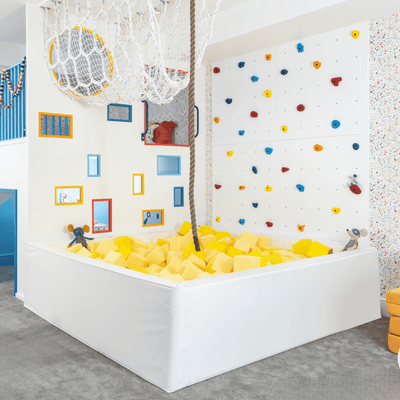
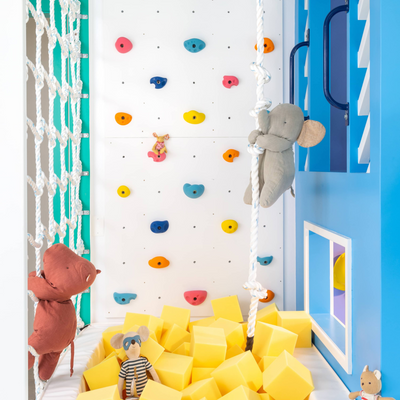
If you want to build a truly dynamic active play zone over time, a foam pit pairs beautifully with vertical active play equipment. Installing climbing panels directly above the pit allows the foam to act as a safe fall attenuation zone. If you want a simple, flexible setup, you can pair the pit with ceiling hookups to easily swap a climbing rope and a rope ladder in and out to keep things fresh.
Why Are Foam Cubes Better Than a Plastic Ball Pit?
Foam cubes are more creative because their flat edges, weight, and solid structures invite open-ended construction, whereas plastic ball pits restrict kids to repetitive, passive movements. Because plastic balls inherently roll away, they tend to prompt throwing and visual clutter.
By contrast, dense foam blocks act as massive, versatile building blocks that allow kids to actively manipulate their environment:
-
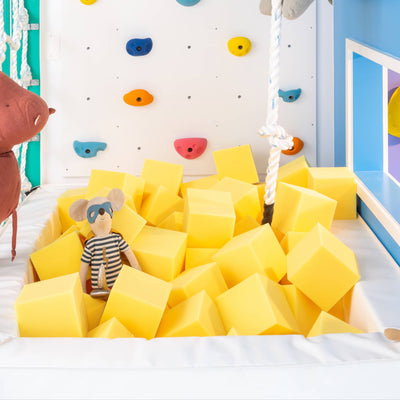
Stacking and Building: Children will spend hours engineering towers, constructing defensive walls, and building forts that plastic balls simply cannot support.
-
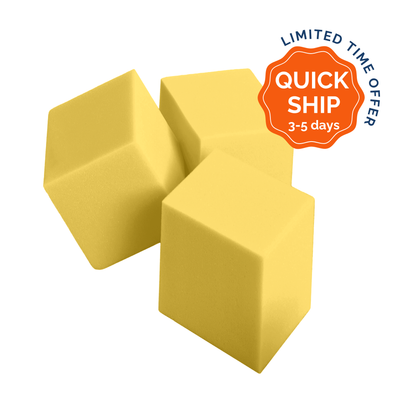
True Shape Recovery: Kids can squish them, squeeze them, and track their sensory boundaries, and the high-density foam always returns to its original shape.
-
Acoustic Absorption: While plastic ball pits create a loud, constant crinkling noise that can overstimulate a sensory-sensitive child, foam naturally absorbs ambient room noise, lowering the overall sensory volume of the house.

How Does a Foam Pit Encourage Sibling Cooperation?
A foam pit encourages sibling cooperation by acting as a shared physical boundary that requires real-time coordination and safety communication. Because only one child can jump or land safely at a time, the physical layout naturally structures their social interactions.
Even when siblings are in a phase of bickering back and forth, the foam pit naturally encourages a completely organic, non-scripted communication routine.
One sibling will look down from an adjacent climbing hold and say, "I need to jump off!" and the other will instinctively move over or climb out of the way. When kids are interacting with an environment that requires active physical safety awareness, they learn to speak up, listen, and look out for each other completely on their own.

Do You Need to Drill Into the Wall or Floors to Install a Foam Pit?
No, you do not need to drill any holes or perform any architectural installation to set up a foam pit in your home. While other sensory regulation products like indoor swings require structurally securing heavy anchors into your ceiling joists, a foam pit is a completely freestanding, standalone powerhouse.
At Groh, our minimum suggested layout is our 5x5 Foam Pit. It takes up a meaningful footprint in a bedroom, a playroom, or an open living space, but it is one of the few pieces that can completely transform a household's play behaviors all by itself.
Our foam pits feature a premium padded floor and are engineered with heavy-duty, 6-inch thick walls. They are structurally sound enough to exist perfectly in the center of a room without needing a wall to lean against, and they are tough enough for a full-grown adult to stand directly on the edges.
When you give big energy an intentional place to go, you stop reacting to the chaos. The couch stays put, your kids get the exact regulatory toolkit they need to thrive, and you finally get your living room back.
Comparison: Ball Pits vs. Foam Cube Pits
| Play Feature | The Plastic Ball Pit | The Groh Foam Cube Pit |
| Instinctive Behavior | Inherently invites throwing and scatters easily across the floor. | Invites stacking, engineering towers, and building defensive walls. |
| Durability & Recovery | Plastic dents, cracks, and stays permanently squished once stepped on. | High-density foam can be squished continuously and always returns to shape. |
| Sensory Output | Creates a loud, constant plastic crinkle that can overstimulate the room. | Absorbs ambient room noise, lowering the overall household sensory volume. |
| Safety Assurance | Balls shift instantly on impact, risking slips straight to the hard floor below. | Compresses perfectly to safely absorb impacts from vertical play features. |