Every parent knows the feeling: you buy a toy covered in buttons and screens, and your kid plays with the packaging instead.
We live in a culture that tells us more features equal better learning, which leaves many of us carrying an unspoken layer of guilt whenever we don't buy the latest "must-have" developmental gadget. But toys don't need to do all the work when your space is designed to invite natural play.
When you stop evaluating toys individually and start looking at how your whole collection functions together, the daily dynamic shifts. Swapping single-purpose toys for open-ended materials transforms your child from a passive spectator into an active, independent problem-solver.
What is the Difference Between Single-Purpose and Open-Ended Toys?
The core difference comes down to who controls the action: the toy or the child. Single-purpose toys offer passive entertainment, while open-ended materials act as tools for active creation.
When play materials have a fixed, unchangeable outcome, a child’s imagination is forced to operate within a narrow boundary:
-
Single-Purpose Toys: These are materials designed with a single, predetermined outcome or task. Think of a plastic phone that plays a pre-recorded song when a button is pressed, or a shape-sorter where each piece only drops through one specific cutout. Once the song finishes or the shapes are matched, the task is complete. The child is simply following a routine built into the toy.
-
Open-Ended Materials: These are versatile tools with zero fixed outcomes, rigid rules, or singular tasks. A simple set of uniform wooden blocks can be a castle today, a highway ramp tomorrow, and a zoo enclosure the next afternoon. The child determines the rules, engineers the structures, and directs the narrative entirely on their own.

Why Do Open-Ended Materials Drive Deeper Focus and Independence?
Open-ended materials drive deeper focus and independence because they remove the frustration of "wrong" answers and allow play to scale naturally with a child's developmental growth.
When a child engages with a single-purpose toy, they quickly hit a mechanical or learning limit. Once they have mastered the specific skill the toy was designed to teach—like pushing a button to trigger a sound or matching a shape—the toy becomes obsolete, leading to boredom and abandonment.
Versatile, open-ended tools eliminate this expiration date:
-
Zero Construction Ceilings: With a deep collection of building materials like magnetic tiles or wooden blocks, a child never runs out of ways to reconfigure their ideas. As their physical coordination and spatial reasoning expand, their builds naturally become larger, more complex, and structurally ambitious.
-
Active Cognitive Engagement: Because the material doesn't dictate the play, the child’s brain must supply the story, the dialogue, and the spatial engineering. This active mental processing keeps executive functioning high and extends independent focus windows significantly.
-
Emotional Resilience: In open-ended play, there are no mistakes—only iterations. If a tower falls, the child hasn't failed a task; they have received an instant lesson in physics and balance, prompting them to rebuild with a stronger base.
Direct from the Play Experts
The Deep Collection Playbook
Start Broad: Offer a small variety of core materials (blocks, tiles, figurines) to see what naturally sparks your child's interest.
Observe & Pick: Identify which category captures their attention most consistently.
Go Deep: Stop buying small, scattered sets across different themes. Instead, build a generous, deep collection of that single favorite material so your child never runs out of pieces mid-build.
How to Audit Your Playroom for Open-Ended Materials
Transitioning your playroom footprint to support open-ended play doesn't mean throwing away every toy you own overnight. It simply means taking a thoughtful look at your current inventory and shifting the balance toward materials that encourage child autonomy.
Use this simple three-step audit to evaluate your space:
-
1. Apply the 10% Rule for Electronics
-
How to Do It: Look at the active toys on your shelves. If a toy relies on batteries, lights up, or talks to your child, cap those items at 10% of your total room layout. Aim to make 90% of your active space hands-on, battery-free tools that require your child's physical input to come alive.
-
-
2. Group by Toy Type inside Your Toy Hub
-
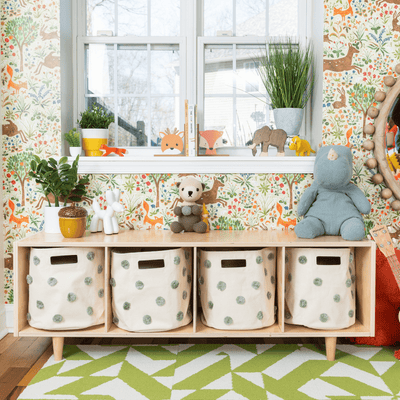
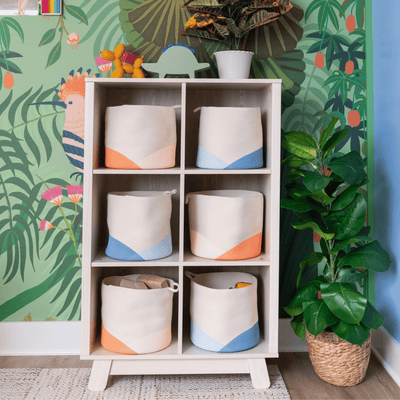
How to Do It: Organize your materials into defined, well-sorted categories by toy type (e.g., building materials in one, figurines in another) within your Toy Hub or main toy storage units. Utilize lidless, opaque bins so visual chaos stays hidden while access remains completely effortless for little hands.
-
-
3. Anchor the Space with Open Floor Canvas
-
How to Do It: Open-ended play requires physical real estate. Keep the perimeter around your toy storage units completely clear of clutter lanes, and swap out squishy, high-pile shaggy rugs for a smooth, low-profile flatweave rug. A flat, stable surface allows towers, tracks, and cityscapes to stand tall without collapsing, protecting your child's hard work and extending their play for hours.
-

Comparison: Single-Purpose Toys vs. Open-Ended Play Materials
| Play Attribute | Single-Purpose Toys | Open-Ended Play Materials |
| Primary Operator | The toy directs the action through lights, sounds, or rigid, single-outcome tasks. | The child directs the action entirely using their own imagination and motor planning. |
| Longevity & Skill Progression | Short-lived; becomes obsolete the moment the child masters the singular skill or novelty. | Multi-year lifespan; the exact same blocks adapt as a toddler grows into an older engineer. |
| Playroom Footprint Impact | High visual clutter; leads to fragmented sets, lost specialized pieces, and rapid bin dumping. | Low-friction layout; easily stored in single-layered, lidless opaque bins inside a Toy Hub. |
| Developmental Return | Passive entertainment; minimal spatial reasoning or creative problem-solving required. | Deep executive functioning, core balance, fine motor refinement, and sustained independent focus. |
| Gifting & Investment Value | High mental load; leads to a constant cycle of buying new toys to replace stale single-use items. | Simplifies holiday gifting; gives family a clear, permanent roadmap to add expansion pieces to deep collections. |