Children have a biological, relentless instinct to test their physical limits. If their environment doesn't offer a dedicated challenge, they will quickly turn your household furniture into a makeshift gym. When parents look for solutions to bring active movement indoors, they usually default to rigid elements—like flat climbing panels or standard wooden rungs. While those features are an incredible foundation, they only tell half the story.
To build an indoor play space that truly satisfies big energy while growing seamlessly with your family, you need to introduce the element of instability.
Dynamic rope and net features—like cargo nets, climbing ropes, tunnels, and rope ladders—introduce a fluid, shifting style of movement that completely transforms how children interact with a room. Bringing a wider variety of these features into your home layout is an essential design shift that maximizes developmental benefits for kids while lowering the daily management load for grownups.
Why is Climbing an Unstable Rope Harder Than a Ladder?
Climbing an unstable rope requires continuous nervous system engagement because the shifting material introduces postural instability. Unlike a rigid ladder where a child moves on autopilot, a moving feature forces the brain to constantly calculate real-time weight adjustments.
Because the material shifts and moves as the child climbs, it forces their body to engage in active motor planning rather than relying on brute physical strength alone.
If a child wants to climb to the top of a rope or execute a launch into a home foam pit, their brain has to calculate an entire sequence of real-time micro-movements:
-
Weight Distribution: They must actively figure out how to shift their center of gravity to steady a moving line.
-
Momentum Calculation: They have to plan how high to climb to achieve the correct swing path.
-
Fine Motor Adjustments: Every single step requires sequencing weight changes, depth perception, and grip compression.
This continuous spatial problem-solving fires up deep core stabilizers, builds hand-grip strength, and sharpens executive functioning skills all while they are just playing.
Direct from the play experts
Cargo Nets Create Distinct Play Zones
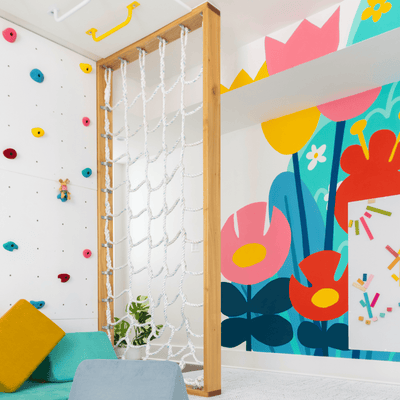
We often integrate the cargo net as a structural spatial border to establish clear, functional play zones without creating a heavy visual impact in your home. By using the net to define clear layout boundaries, you keep big, active body movements contained to a specific area.
This layout creates a beautifully balanced room, especially when multiple kids are sharing the space. While one child is engaging in high-energy active play on the circuit, another can be nearby having a quiet moment building with blocks or reading, completely undisturbed because the environment has naturally separated their activities.
How Big of a Cargo Net Layout Fits an 8.5-Foot Ceiling?
An 8.5-foot residential ceiling perfectly accommodates our standard nets, which are hand-tied into safe, 9-inch entrapment-free squares. You can easily round your sizing choice up or down to customize the physical challenge based on your family's needs:
-
For a More Taut, More Stable Climb: Choose the 4x8 size. This tighter footprint provides less sway for beginners.
-
For a Looser, Wiggly Challenge: Choose the 4x9 size. This adds length, allowing the net to drape and create a more complex balance obstacle.
Both options are completely safe, both work beautifully in a standard residential footprint, and if your layout requires a truly bespoke fit, we can create a custom size for your space.
Where Can You Install a Rope Tunnel?
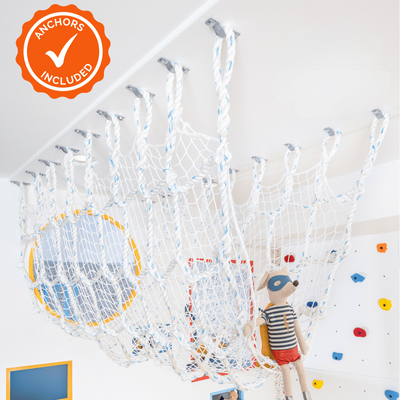
A rope tunnel is most often installed on the ceiling to take advantage of completely unused, elevated real estate. Unlike traditional floor-bound tunnels that can restrict foot traffic and split the flow of a room, this elevated asset functions as an open-air suspension bridge across an active play circuit.
This aerial configuration gives kids a brand-new crawling challenge that tests their depth perception and spatial awareness in a totally secure environment.
Because our rope tunnels utilize a spacious, hand-tied 9-inch cargo net base lined with a soft, durable interior bedding mesh, they form a graceful, rounded "U-shape" drop. This careful geometry ensures the tunnel hangs with perfectly balanced tension, allowing children to comfortably crawl through, transition between platforms, or navigate an elevated route without the material pinching or restricting their movement.
How Do Ceiling Hookups Function as a Behavioral Volume Dial?
Ceiling hookups function as a physical volume dial by allowing grown-ups to unclip active equipment and take it down whenever a space becomes too chaotic. When parents try to pack every single active feature into a room at the same time, the environment quickly becomes overcrowded, visually loud, and tough to manage.
By treating your ceiling as an adaptable utility system with a few simple hookups, you solve visual clutter while gaining total control over the room's energy:
-
Multi-Point Ceiling Hookups: Creates an active invitation for kids to problem-solve spatial engineering and geometry on the fly. To swing from a rope and stick the landing in a foam pit, they must independently figure out which hook yields the right momentum and how high they need to climb to execute their plan.
-
Pre-Knotted, Extended Rope Length: Delivers instant physical stability for early learners. The intentional, extra length allows the excess rope to pool comfortably at the bottom of a foam pit so beginners can anchor it with their feet and steady their body weight as they build core confidence.
-
Built-In Grownup Control: Offers immediate parental versatility without the headache of constantly adjusting gear. The built-in extra length means an adult can easily step in, grab the base of the line, and stabilize the rope for a younger climber without ever having to untie a single knot.
If you have a toddler and a tween sharing a space, you can effortlessly unclip the advanced features when only the toddler is navigating the room. Similarly, when friends are over and features hanging from the ceiling naturally invite a bit of fast-paced chaos, you don't have to police behavior with your voice. You can simply remove the invitation entirely by taking the rope down for the afternoon.

What Are the 4 Essential Net & Rope Assets for High-Energy Spaces?
Building a sustainable active play zone at home isn't about fixing permanent equipment to every surface until the room is overcrowded. The goal is to build an open-ended foundation that can easily adapt as your family grows. If you want to design a multi-layered gross motor circuit that keeps executive functioning high and visual chaos low, these four elements are the ultimate layout anchors:
-
1. The Cargo Net
-
The Role in Your Circuit: Spatial boundaries and open-air traversing.
-
How to Build It: Installed inside a structural frame, the cargo net serves as an architectural room divider that defines specific zones without blocking natural light. It forces children to use dynamic motor planning and engage deep core stabilizers as they climb across, separating high-energy circuits from adjacent quiet play spaces.
-
-
2. The Climbing Rope
-
The Role in Your Circuit: Upward ascent and dynamic launch points.
-
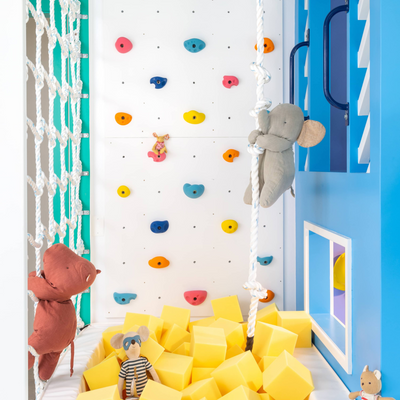
How to Build It: Dropped straight from a ceiling anchor over a foam pit, this feature offers incredible physical resistance. Because our ropes feature a 1.25-inch thick diameter and come pre-knotted with extra length, they pool safely at the bottom of a pit—giving beginners a stable foot anchor to steady their weight, or allowing adults to step on the base to guide a young toddler working on grip strength.
-
-
3. The Rope Tunnel
-
The Role in Your Circuit: Aerial bridging and elevated spatial challenges.
-
How to Build It: Built on a hand-tied 9-inch cargo net base lined with a soft interior bedding mesh, its unique geometry creates a rounded "U-shape" drop. Suspended across completely unused overhead space, it serves as an aerial bridge that safely challenges a child's depth perception.
-
-
4. The Rope Ladder
-
The Role in Your Circuit: Vertical transitions and coordinate balance.
-
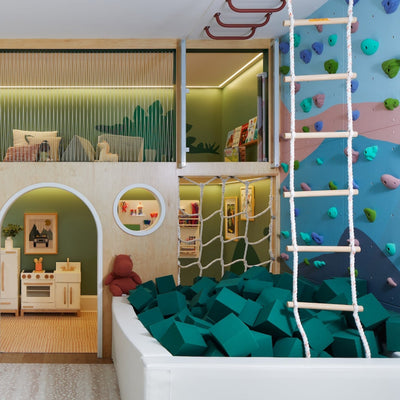
How to Build It: Hanging directly from standard ceiling hookups, the rope ladder acts as an excellent mid-level difficulty transition between floor mats and elevated structures. Because it relies on flexible ceiling attachments rather than rigid wall mounts, it introduces an element of balance challenge that trains core stabilization far more effectively than any fixed playground rung.
-
Comparison: Motor Planning vs. Autopilot Play
| Feature Type | Child's Brain State | Muscle Group Engagement | Spatial Problem Solving |
| Rigid Features (Standard Ladders, Fixed Wood Rungs) | Autopilot Navigation: The brain moves automatically because distances are completely predictable. | Primarily targeted group muscle use (brute force lifting). | Low: The surface doesn't react, meaning no adjustments are required. |
| Unstable Features (Cargo Nets, Ropes, Tunnels) | Active Motor Planning: The nervous system continuously recalculates body weight adjustments in real-time. | Total physical engagement; activates fine stabilizers, grip compression, and deep core muscles. | High: Every step requires the user to sequence weight changes, depth, and momentum. |